The story of Woodruff
A crossroads tavern on the old Buncombe Road became a railroad town, a mill town and a football town. Here is Woodruff’s story, told from the record with every source linked so you can read further.
- 1787Joseph Woodruff and family are among the first deacons at Jamey’s CreekSource ↗
- 1874Town chartered, with about 150 residentsSource ↗
- 1885The railroad arrives. About 1,600 people live here by 1886Source ↗
- 200,000+Peach trees within ten miles before World War IISource ↗
- 10State football titles under Coach Willie VarnerSource ↗
-
1787 – 1873
01 A crossroads and a tavern
Woodruff grew up where two old roads met: the Buncombe Road, which ran from Charleston toward the mountains, and the Georgia Road. The families who settled here after the Revolution included Joseph Woodruff and his brothers. In 1787 they appear as members and deacons in the earliest minutes of the Church of Christ at Jamey’s Creek, the congregation that became Woodruff Baptist Church. By 1789 Joseph Woodruff had bought two hundred acres on the creek, land that takes in the site of today’s town.
By 1825 the crossroads was known for two things: a post office, named for its postmaster Thomas Woodruff (Joseph’s son), and Woodruff’s Tavern. Surrounded by cotton country, the settlement became the place where farm families came to trade. By the 1850s it hosted large fairs for livestock and home-made goods.
Sources: scencyclopedia.org ↗ · scpictureproject.org ↗
-
c. 1795 – 1821
02 Price’s Post Office, and the people enslaved there
A few miles northeast of town stands a house older than Woodruff itself. Thomas Price came to the Spartanburg District around 1793. About 1795 he and his wife Anne built a two-and-a-half-story brick house with a steep gambrel roof and Flemish-bond walls, a style more common in the Chesapeake than in the Upcountry. From it the Prices ran a general store, a tavern and an inn on the stagecoach road toward Cross Anchor. From about 1811 to 1820 the store was also the post office, so the place appeared on maps as “Price’s P.O.” Travelers slept in dormitory rooms under the roof.
That business, and the 2,000 acres of cattle, corn and cotton around it, ran on the labor of enslaved African Americans. The record names a few of them. A 1794 bill of sale lists a woman named Phillis and a child named Harry, bought the same year Price bought his first land here. An enslaved man named George kept the store when Price was away. When Thomas Price died in 1820 he enslaved twenty-four people. Little else is known about their lives, and the historical association that keeps the house says so plainly.
The house passed to the Dean family after the Civil War and later came to the Spartanburg County Historical Association. (Our sources differ on when: one says about 1936, another says 1968, followed by four years of restoration.) It was listed on the National Register of Historic Places in 1969. Today it is a museum with a typical Upcountry slave cabin on the grounds (moved there, not original) so that visitors hear the whole story. The house is currently closed for renovations.
Visit today: Historic Price House →
Sources: spartanburghistory.org ↗ · en.wikipedia.org ↗ · theclio.com ↗ · loc.gov ↗

The Price House as documented by the Historic American Buildings Survey (photo SC-624-1). The brick walls, the dormers under the roof where travelers slept, and a frame outbuilding at left are all visible. Historic American Buildings Survey, HABS SC-624-1. Public domain: no known restrictions (made by the U.S. government). Digital image: Library of Congress ↗ Around and inside the house  Front and end, seen at an angle SC-624-4
 The gambrel end and a one-story wing SC-624-6
 From the rear SC-624-9
 A dining room SC-624-11
 A brick cooking hearth SC-624-13
Historic American Buildings Survey, HABS SC-624, photos 4, 6, 9, 11, 13. Public domain: no known restrictions (made by the U.S. government). Digital images: Library of Congress ↗
A brick cooking hearth SC-624-13
Historic American Buildings Survey, HABS SC-624, photos 4, 6, 9, 11, 13. Public domain: no known restrictions (made by the U.S. government). Digital images: Library of Congress ↗
-
1874 – 1897
03 A charter, then the railroad
Thomas Woodruff wanted the community to become an official town. He didn’t live to see it, but his two sons carried the idea through, and Woodruff was chartered in 1874 with roughly 150 people.
The railroad changed everything. After the line reached Woodruff in 1885, the population jumped to an estimated 1,600 within a year. Woodruff was the end of the line, and its station had a turntable to send trains back toward Augusta, Georgia. Through the 1880s and ’90s Main Street filled in, with the popular Leatherwood Hotel at its center. A fair that began in the 1870s had become a major yearly draw by the 1890s, pulling visitors from as far as North Carolina.
Sources: scencyclopedia.org ↗ · scpictureproject.org ↗
-
1898 – 1945
04 Cotton oil, cotton mills and peaches
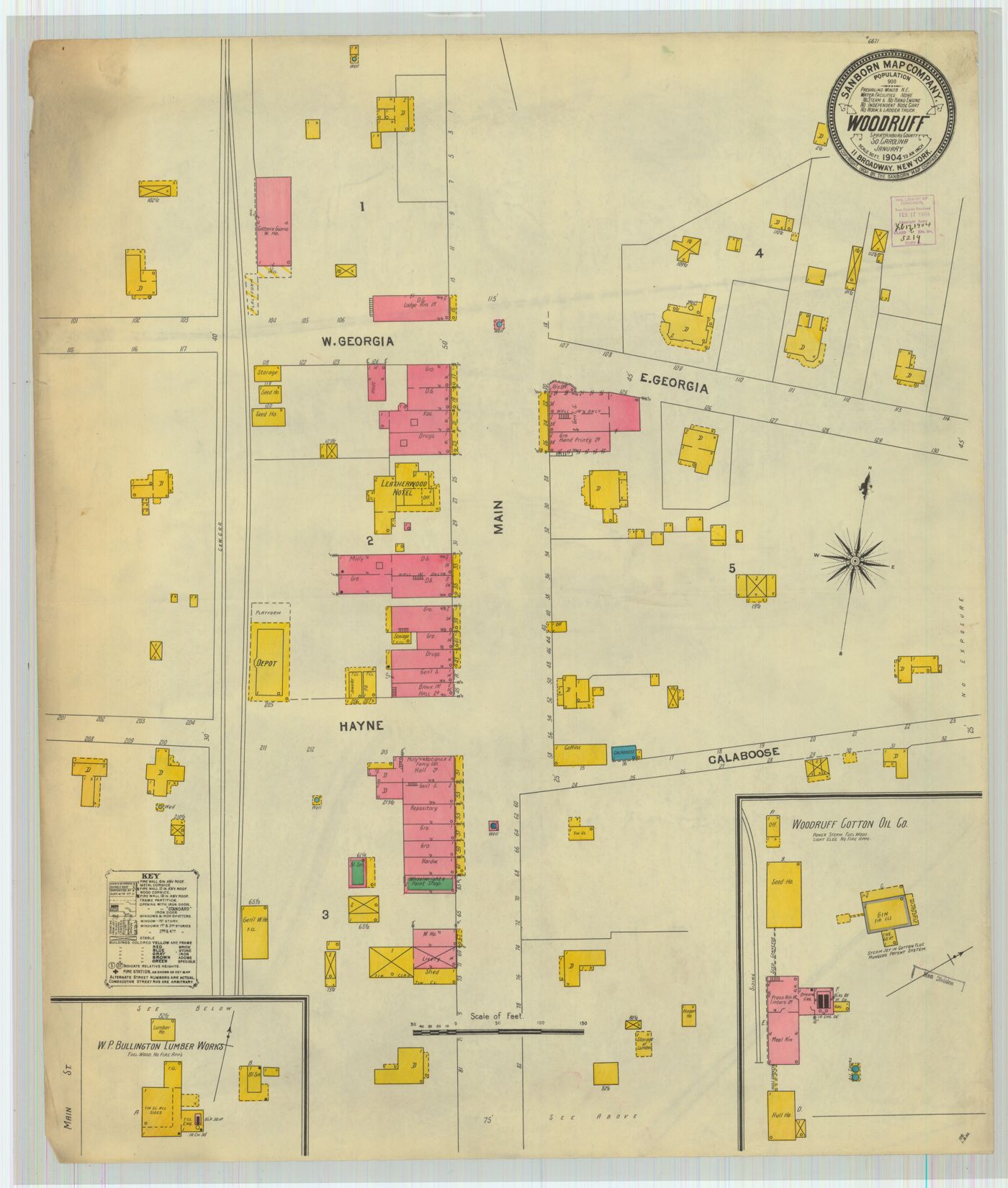
Industry arrived in 1898 with the Woodruff Cotton Oil Company, which you can see at the lower right of the 1904 map above. Within three years a newly chartered Woodruff Cotton Mill was running. The W. S. Gray Cotton Mill followed by 1907, and its mill houses widened the town’s neighborhoods.
Those early years were not easy. On the morning of March 28, 1907, the oil mill’s large brick building burned, a $15,000 loss reported by the Rock Hill Record. The company was headed by Dr. L. H. Irby. The cotton mill itself went on to change names more than once: first the Woodruff Cotton Mill, then the Brandon Mill, and later the Abney Mill. That last name lives on in the Abney Mills neighborhood of mill-era houses near downtown.
Until World War II, the one big alternative to textiles was fruit. More than 200,000 peach trees grew within ten miles of town.
Sources: scencyclopedia.org ↗ · rootsandrecall.com ↗
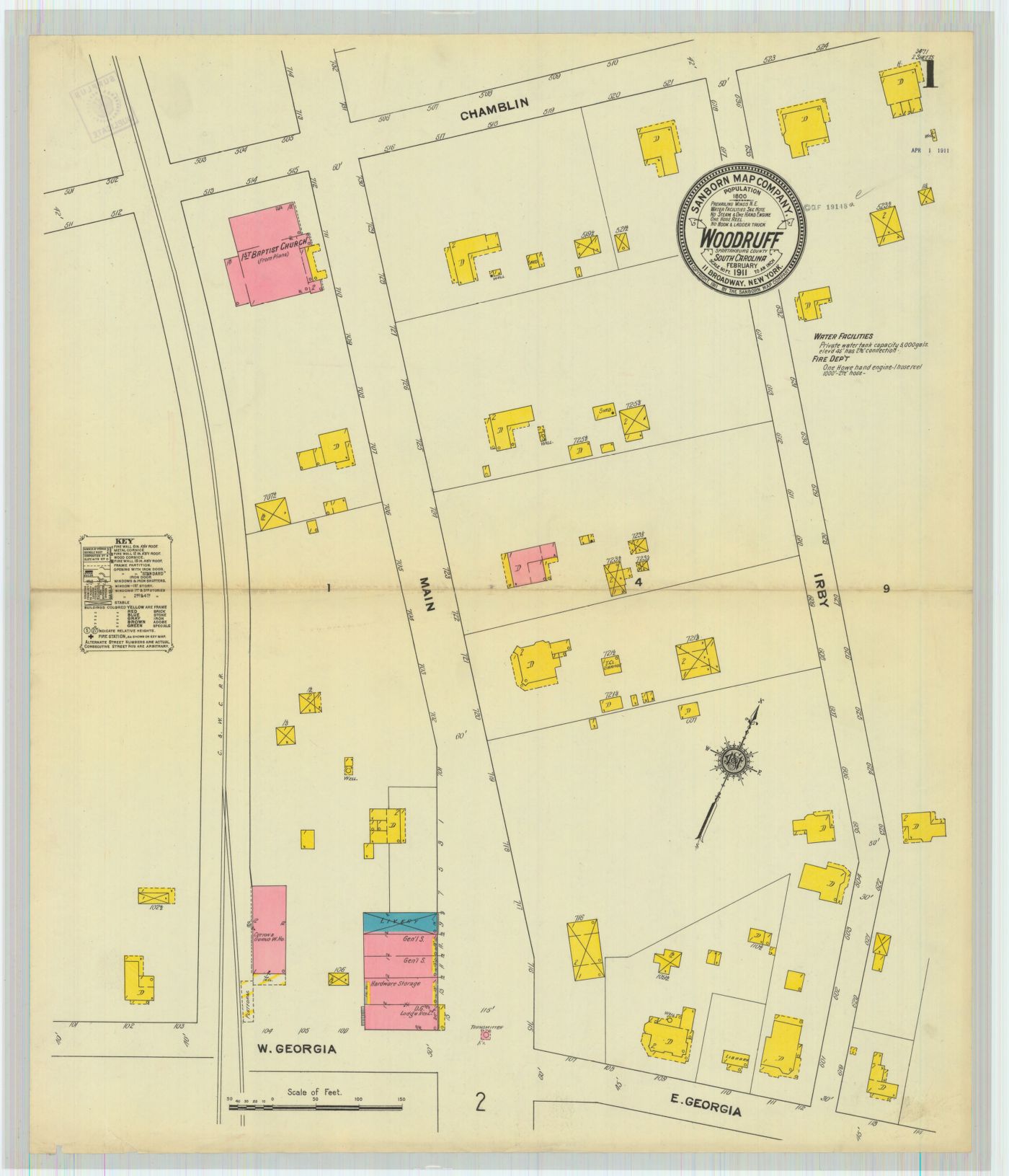
Seven years later, February 1911 (sheet 1). The map’s seal now reads population 1,800. North Main and Irby streets are lined with homes, and the brick 1st Baptist Church stands beside the railroad. The town’s fire protection was one hand engine and a hose reel. Sanborn Map Company, 1911. Public domain in the United States (published before 1929). Digital image: USC Libraries ↗ -
1911 – 1953
05 Brick, stained glass and a Collegiate Gothic school
Two buildings from this era are now on the National Register of Historic Places. The First Presbyterian Church of Woodruff (Associate Reformed Presbyterian from 1953) was completed in 1911 and dedicated in 1912. It was designed by Spartanburg County architect Luther D. Proffitt, mixing Romanesque and Gothic Revival touches under a standing-seam metal roof. It was listed in 2005. Today it’s a private building, so please enjoy it from the street.
Woodruff High School was built in 1925 for $50,000. Greenville architects Frank H. and Joseph G. Cunningham designed it in the Collegiate Gothic style, with a 600-seat auditorium. It replaced the first high school of 1908 on East Georgia Street and served as the high school until a new campus opened in September 1953.
Visit today: Old Woodruff High School →First Presbyterian building (1911) →
Sources: nationalregister.sc.gov ↗ · nationalregister.sc.gov ↗
-
1954 – 1996
06 The Varner years
For many South Carolinians, Woodruff means Wolverines football. W. L. “Willie” Varner coached at Woodruff High for 42 seasons, from 1954 to 1996, winning 383 games, 10 state championships and 28 conference titles. That includes four straight state titles from 1975 to 1978 and a combined 28–0 run over the 1983 and 1984 championship seasons.
Varner was named National High School Coach of the Year in 1983, received the Order of the Palmetto in 1996, and is in the National High School Hall of Fame. One of his quarterbacks, Tony Rice, went on to lead Notre Dame to a national championship.
Sources: en.wikipedia.org ↗ · scencyclopedia.org ↗
-
1954 – today
07 New industry, a new city hall, a renewed downtown
Woodruff’s population dipped about four percent in the 1950s as industry clustered near bigger cities. It recovered when Jeffery Manufacturing, an industrial-equipment maker, opened a plant in 1962. By 1970 the town had grown to about 4,600 people.
In 1978 the city bought the old 1925 high school and turned it into City Hall and police headquarters. It still serves that purpose. In the mid-1980s Woodruff moved to a council–manager government while working through lean years. In 2001 a $1.1 million grant-funded downtown project replaced the sidewalks, added decorative lighting and buried the overhead wires.
Sources: scencyclopedia.org ↗ · nationalregister.sc.gov ↗
-
1983 – today
08 Wings over Woodruff: Triple Tree and Joe Nall
Greenville native Pat Hartness started flying model airplanes at age seven. At Furman University he met his best friend, Joseph T. Nall, who shared that passion. Nall became a pastor, then a lawyer and a flight instructor. In 1986 President Reagan appointed him to the National Transportation Safety Board. From 1982 until 1989, Nall was the master of ceremonies at the giant-scale model fly-ins Hartness hosted at his family’s airfield in Greenville. The first of these events, the Big Bird Fly-In, was held in 1983.
Nall died in 1989 in an aircraft accident in Caracas, Venezuela, while on official business. The next year Hartness renamed the gathering the Joe Nall Fly-In in his friend’s honor. In 1997 Hartness bought land near Woodruff and began shaping it into Triple Tree Aerodrome. He set it up as a nonprofit and gave it the land. Today Joe Nall Week and the Triple Tree Fly-In bring thousands of pilots and model flyers to Woodruff each year, from across the country and around the world.
Visit today: Triple Tree Aerodrome →
Sources: tta.aero ↗ · tta.aero ↗
-
1987 – today
09 Fire, rock ’n’ roll and a new campus
On January 11, 1987, an arson fire destroyed the Woodruff High School building that had opened in 1953. Students suddenly had no school. Help came from an unlikely place: the rock band REO Speedwagon played a benefit at the Greenville Memorial Auditorium to help that year’s seniors. The band followed it with an August 14 concert at Clemson University, expected to draw about 9,000 people, to raise money for a new building. Singer Kevin Cronin said the band wanted to “send out a positive signal that education is important.”
The rebuilt Woodruff High opened for the school year that began on August 13, 1989. A generation later the town had outgrown it. On August 11, 2022, voters approved a $100 million bond referendum for a new high school, and ground was broken on Cross Anchor Road on June 28, 2023. The new campus was designed for 1,500 students at first, with room to grow to 2,000, and it is the Wolverines’ home today.
Sources: upi.com ↗ · en.wikipedia.org ↗ · wspa.com ↗ · whs.spartanburg4.org ↗
Woodruff in numbers, 1880–2020
Population at each U.S. Census. Watch the jump when the mills arrived after 1900.
Source: Wikipedia — Woodruff, South Carolina (U.S. Decennial Census table) ↗
Sources
This page summarizes these sources in our own words. Please read the originals.
- South Carolina Encyclopedia — “Woodruff” (Steve Richardson, USC Institute for Southern Studies) ↗
- South Carolina Picture Project — Woodruff ↗
- SC Dept. of Archives & History — National Register: Woodruff High School ↗
- SC Dept. of Archives & History — National Register: First Presbyterian Church of Woodruff ↗
- Wikipedia — Willie Varner ↗
- Wikipedia — Woodruff, South Carolina (U.S. Decennial Census table) ↗
- Sanborn Fire Insurance Map, Woodruff, January 1904 — University of South Carolina Libraries ↗
- Sanborn Fire Insurance Map, Woodruff, February 1911 (sheet 1) — University of South Carolina Libraries ↗
- UPI Archives — “School to be built on rock” (William C. Trott, July 2, 1987) ↗
- Wikipedia — Woodruff High School (South Carolina) ↗
- WSPA — “Spartanburg School District 4 breaks ground on new Woodruff High School” ↗
- Woodruff High School — official site (Spartanburg County School District 4) ↗
- Triple Tree Aerodrome — “Who was Joe Nall?” (official site) ↗
- Triple Tree Aerodrome — “Our Founder: Pat Hartness” (official site) ↗
- Roots & Recall — “Woodruff Cotton Mill and Community” (Winthrop University Pettus Archives network) ↗
- Spartanburg County Historical Association — “The Price House” (official site) ↗
- Wikipedia — Price’s Post Office (NRHP #69000174) ↗
- Clio — “Price House” (Marshall University entry) ↗
- Library of Congress — Historic American Buildings Survey SC-624, Price House (13 photos) ↗